
Behind the
Full Room
Why successful hospitality businesses still depend on the owner — and how to change it.
A full room can hide a fragmented business.
How big can
your business
become?
And can the organisation you have today carry the business you imagine tomorrow?
You may already have built something successful. The room is full. Revenue is real. Managers are in place.
But ambition creates a different question.
If important decisions still travel to you, standards strengthen when you are present, and difficult problems repeatedly wait for your judgement — what happens when the business becomes larger, more complex or more ambitious?
The more the business grows, the more there is for you to carry.
Behind the Full Room is about changing that — not by making you less important or asking you to step away, but by building stronger managers, clearer ownership and an organisation capable of carrying more of what you want to build next.
Because the size of your ambition should not be limited by the amount of the business you can personally carry.
They are waiting for your decision.
Again.
The call that should never have reached me.
One of roughly 300 stores had a problem. A logistics partner had failed to collect a shipment on time.
Between that store and me — Director of Operations — there were department managers, assistant managers, supervisors and experienced senior employees. There was no shortage of structure. There was no shortage of management.
Yet the question still travelled upward.
“What do you want us to do?”
So I started asking questions. Had the partner been contacted? Yes. Did we understand why the collection was missed? Yes. Were alternatives available? Yes. Did the people responsible understand the operational and financial implications? They did.
The information required to make the decision was already inside the organisation.
The people required to act were already inside the organisation.
The management structure required to own the problem was already inside the organisation.
And yet the decision had travelled all the way to me.
Dependency rarely begins with anyone saying I want everyone to depend on me. It begins with something far more reasonable: I can help. Someone brings you a problem. You understand it. You decide. The problem disappears. And somewhere in that exchange, both sides receive a reward — they receive certainty, and you receive confirmation that your experience has value.
That is why the pattern is so hard to see. Being needed does not feel like failure. It feels like competence.
The five signs of a
fragmented business.
A hospitality business is fragmented when its numbers, people, operations, marketing and guest experience function as separate activities rather than one connected management system. The company does not lack activity. It lacks connection.
Numbers are reported, but they do not drive decisions
Marketing reports reach and bookings. Operations reports staffing and stock. Finance reports cost. Each area is accurate — and nobody is assigned to turn the combination into one decision. A report creates visibility only when someone is responsible for turning it into action.
Responsibility exists, but ownership remains unclear
“We all need to pay more attention.” “Someone needs to speak to the staff.” These statements express concern. They do not create accountability. Everyone contributing is not the same as someone being accountable — and without one clear owner, the problem drifts sideways, then upward.
Standards depend on who is working
Managers already know which shifts will perform well before they begin. If quality depends on the owner or the strongest employee being present, the standard is personal. The business does not yet own it — individuals do.
Demand and operations are managed separately
Marketing can correctly report that it filled the room. Operations can correctly report that the room was impossible to serve. Both reports can be true — the failure lies in the missing connection between them.
The owner acts as the connection between everything
The gaps do not remain empty. Someone fills them — combining what the accountant reported, what the GM said, what guests complained about, what was agreed in a meeting nobody else fully remembers. The owner is not only leading the system. The owner has become the system.
The ORDYX
Clarity-to-Execution Loop.
One discipline, applied to one real problem at a time. The sequence is deliberately simple. The organisational challenge behind it is not.
The objective is not another report, another meeting, another dashboard, another SOP or another management layer. Add a layer and the pattern often stays exactly the same. The objective is an organisation that can increasingly see, think, decide, act and learn without requiring one person to connect every step.
Five parts. Ten chapters.
One way of thinking.
Read it from beginning to end the first time — the ideas build on one another. But do not give every page the same attention. Some will confirm what you already know. Others may challenge an assumption you have carried for years.
- 01 A Full Room Is Not the Whole Story
- 02 Revenue Can Hide the Cost of Chaos
- 03 The Five Signs of a Fragmented Business
- 04 When the Owner Becomes the Operating System
- 05 Your Manager May Still Be a Supervisor
- 06 One Priority, One Owner, One Result
- 07 Standards That Protect the Human Experience
- 08 When Demand Meets Capacity
- 09 Close the Loop
- 10 Replace One Recurring Intervention
- — Conclusion: The Owner's New Role
Behind the Room
Recurring prompts that ask you to stop and think about your own operation, not the one on the page.
Put It to Work
One small action through which to test each idea inside the real operation this week.
The 30-Day Control Reset
A closing exercise: one recurring problem, one owner, one verified result, thirty days.
Glossary
The working vocabulary — fragmentation, ownership, standards, verification — defined precisely.
If you disappeared from the operation for thirty days — not from ownership, not from leadership, but from routine intervention — what would worry you most?
Mark the ones that just produced a name, a shift, or a specific problem.
Owners who built something that works — and know what it costs to keep it working.
- Hospitality owners and founders
- General managers and senior operational leaders
- Multi-site groups and single independent venues
- Anyone whose business performs well while too much of it still runs through one person
This is not a book about collecting management tools. It is a book about learning to see your business more clearly.
Chapter 3 names all five signs. The 30-Day Control Reset asks you to change one — and only one.
Buy on AmazonThe 30-Day Control Reset
You have spent the book looking behind the room. Now stop reading — and look at your own. The purpose of the next thirty days is not to implement this book. Please do not try.
Do not
- ✕ Redesign your organisation
- ✕ Introduce ten new meetings
- ✕ Distribute a new list of rules to your managers
- ✕ Announce a transformation programme
Instead
- → Choose one recurring problem — small enough to observe, important enough to matter
- → Run the Loop once: SEE, EXPLAIN, CHOOSE, OWN, VERIFY
- → Take one sheet of paper and ten uninterrupted minutes
- → Write what is true, not what sounds like management
Your objective is not simply to make the problem disappear. It is to discover whether the organisation can become capable of producing the result without unnecessary dependence on you.
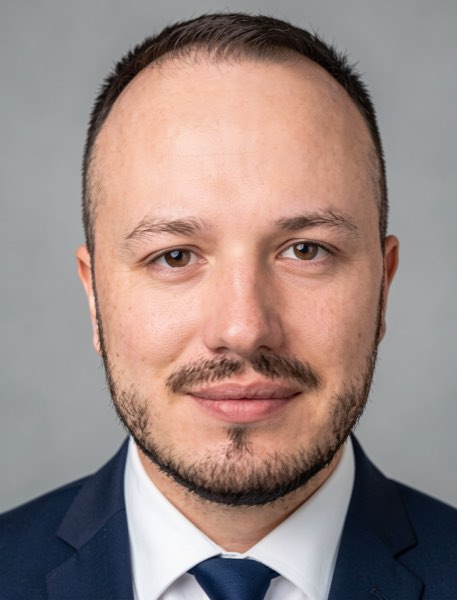
One question has followed Stefan across every industry, organisation and country he has worked in: what makes an organisation capable of turning good people, good information and real ambition into a business that works as one system — rather than one that works because a few people carry it?
He has looked at that question from the inside, from the places where people, information, operations and decisions are supposed to meet. The titles mattered less than the view they gave him — how one decision in operations becomes a consequence in finance, or in what a guest feels; how information travels up three levels of management and arrives as a question instead of a decision; how a company can employ capable people, sophisticated systems and several layers of management while the judgement that matters still sits with a handful of individuals.
He also recognised the pattern in himself. Being the person everyone came to felt like competence, not like a constraint — which is precisely what makes it so hard to see. Behind the Full Room began with that recognition.
His perspective stays deliberately practical. He continues to study across disciplines including psychology and law, because management does not happen inside spreadsheets and procedures. It happens through people, judgement, incentives, trust, and the decisions people make when the answer is not already written down.
For the record. A market-development project with Philip Morris at nineteen · pre-opening of three Starwood and Marriott hotels in Dubai · five years in large-scale consumer electronics and home-appliance retail, progressing to Deputy General Manager and, by twenty-five, Director of Operations and a member of the management board of a major corporate group · restaurant management in Belgrade · founder of ORDYX Group, Frankfurt am Main, working with hospitality businesses across Europe.
The objective is not to remove the owner from the business. It is to help build a business capable of carrying more of what the owner has spent years carrying personally.
What this book claims —
and what it does not.
No promised numbers
The book makes no guarantee that applying these ideas will increase revenue or produce any specific commercial result. An observed missed opportunity is not automatically a documented financial loss.
Observation, not invention
Personal observations describe situations witnessed directly. Anonymised examples protect the people involved. Composite scenarios are labelled as such — never offered as documented case studies.
Not a universal formula
Hospitality businesses differ by concept, location, market and operating model. The Loop does not ask you to accept a formula. It asks you to test one assumption inside your own business.
Not a book of tools
The aim is not fifty new tasks. It is greater clarity about one or two things that matter — where a decision is unnecessarily travelling upward, or one recurring intervention you are ready to stop carrying personally.
The Hospitality Behind™ Series.
Three perspectives on the business behind the guest experience.
Each one looks behind something a hospitality business is usually judged by — the room, the revenue, the name.
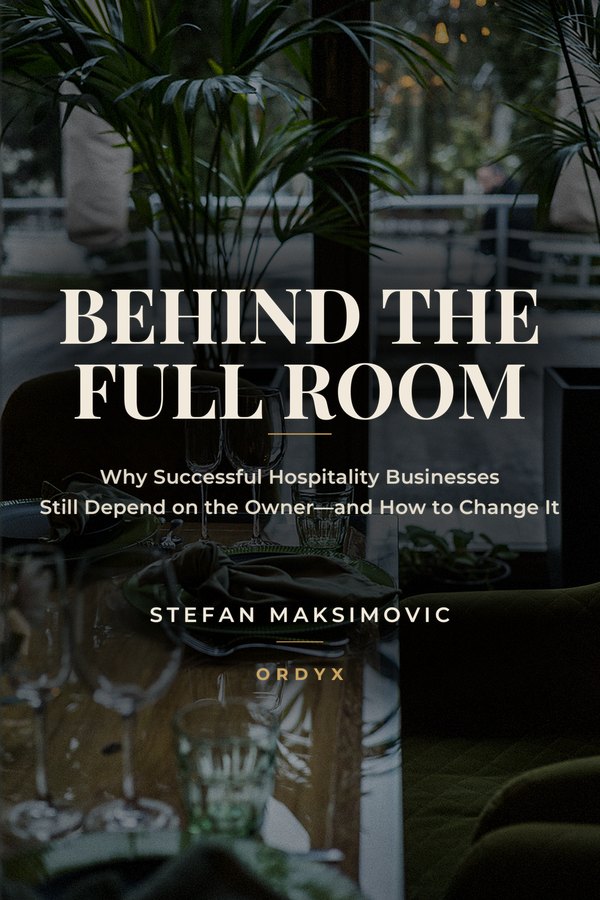
Behind the Full Room
Why successful hospitality businesses still depend on the owner — and how to change it.

Behind the Revenue
How hospitality owners create more value, grow sales and build lasting profit.
Behind the Brand
There may be something behind the full room worth seeing.
Behind the Full Room is available in paperback on Amazon.